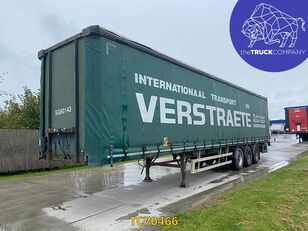
Desot semi-trailers
8 ads: Desot semi-trailers
Desot Semi-Trailers: Specifications, Use Cases, and Market Fit in Nigeria
Overview of Desot semi-trailers
Desot semi-trailers are heavy-duty towed units designed for high-volume freight movement behind a tractor head. Their primary purpose is to increase payload efficiency and route flexibility across regional and long-haul operations. In the semi-trailer segment, the Desot name is associated with practical engineering and fleet-focused durability, making it a common consideration where uptime, parts availability, and straightforward maintenance matter.
Technical profile and operating advantages
Typical configurations include flatbed, skeletal/container, tipper, and curtain-side bodies, depending on cargo type and loading infrastructure. Construction generally focuses on reinforced chassis members, robust suspension choices (often air or mechanical), and braking systems compatible with common tractor specifications. Key practical strengths for operators include:
- Payload-optimized frame design for improved ton-km efficiency
- Options for multi-axle layouts to suit axle-load regulations and road conditions
- Durable running gear intended for intensive fleet cycles
- Compatibility with standard coupling, braking, and lighting interfaces
Compared with many generic imports, these trailers are often valued for predictable service intervals, simpler repair workflows, and configurations that align with mainstream logistics needs.
Relevance in Nigeria: routes, loads, and conditions
In Nigeria, semi-trailers play a central role in moving containers, building materials, FMCG, agricultural produce, and petroleum-adjacent supplies between ports, industrial zones, and inland distribution hubs. Demand is influenced by mixed road quality, high utilization rates, and seasonal weather impacts. Heat, dust, and heavy rainfall increase wear on tires, suspension, and braking components, so operators prioritize rugged chassis design and easy access to consumables. Economic realities—fuel costs, turnaround time at depots, and maintenance budgeting—also make reliability and load efficiency key factors when evaluating options.
Who it suits and what to check when comparing price and sale listings
These units are typically suitable for fleet managers, owner-operators, and contractors needing consistent haulage capacity across varied routes. Common reasons to shortlist them include operational compatibility with existing tractors, cargo-specific body choices, and serviceability. When reviewing Desot semi-trailers price or sale listings, it is practical to compare axle configuration, brake condition, suspension type, chassis integrity, and documentation to ensure the trailer matches route demands and compliance requirements.
Prices for Desot semi-trailers
| Desot OPL-2AT | Year: 1998, load cap.: 25,500 kg, net weight: 6,500 kg, number of axles: 2 | €2,250 |
| Desot Skelet 20-30 ft | Year: 2001, suspension: air/air, net weight: 4,080 kg, number of axles: 3 | €2,850 |
| Desot | Year: 1999 | €4,500 |
| Desot nice 20FT/30FT ADR-Chassis for SMALL PRICE, liftaxle, 5 twistloc | Year: 1994, load cap.: 33,200 kg, net weight: 4,800 kg, number of axles: 3 | €2,500 |
| Desot OPC3AT-38-98B 20/30FT APK NL trailer | Year: 1998, load cap.: 31,730 kg, net weight: 7,270 kg, number of axles: 3 | €2,400 |
| Desot OPL/3AT/38/6894E 3-Axles BPW - Drum Brakes - 30FT Tipper Chassis | Year: 1998, load cap.: 33,820 kg, net weight: 5,180 kg, number of axles: 3 | €5,950 |
| Desot OPP 3AT 38 78136 3-Axles ROR - Drum brakes - 20FT 2x20FT 30FT 40 | Year: 2003, load cap.: 33,100 kg, net weight: 4,900 kg, number of axles: 3 | €3,950 |
| Desot 20FT/30FT ADR-Chassis, Liftachse, Heckbundig, 2x vorhanden | Year: 1994, load cap.: 33,200 kg, net weight: 4,800 kg, number of axles: 3 | €2,500 |